
College Park Resident Lookup Records
A single person can leave traces in several separate Maryland and Prince George's County systems. The SDAT Real Property Search works from an address, account, map reference, or sale. It confirms a recorded owner and parcel facts, not a household roster. Maryland CaseSearch indexes courts statewide. Estate files, licenses, business records, and historical directories answer their own identity questions. Pick the record that fits the fact you need. Then test it against an independent date or address.
| Record | What It Confirms | Where | Access Coverage |
|---|---|---|---|
| SDAT parcel card | Recorded owner, premises and mailing fields, deed reference, parcel keys | Maryland SDAT | Free public result; no primary owner-name or ZIP search, and no full occupant list |
| Recorded land record | Grantor, grantee, instrument, book and page | MDLandRec | Public self-research; current images need a free account and two-factor sign-in |
| Court index | Indexed party, case number, event history, charge or disposition details | Maryland CaseSearch | Public summary with CAPTCHA, varying coverage, exclusions, and a 500-result cap |
| Voter record | A person's own registration match, polling place, districts, and status | Maryland Voter Search | Identity-gated self-lookup; requested voter products have oath, fee, and use limits |
| Vital or probate record | An event, relationship, decedent, representative, or historical reference | MDH Vital Records or the Register of Wills | Certificates are eligibility based; historical Archives paths and estate files vary by date |
Start from the question, not the database. For a current address lead, begin with an exact premises address. Note the parcel account plus the deed reference. A dated legal or family event points elsewhere. Try the court, estate, or archival index first. Watch the mailing address on an assessment card. It may belong to a business, a representative, or an old contact. The addressee may not be the owner. Never treat that line alone as proof of where a person lives.
College Park CaseSearch Name Results
Maryland CaseSearch earns its keep when a name needs a court-based date, case number, party role, or disposition to separate it from a same-named neighbor. Coverage is statewide for District and Circuit Courts, not a separate College Park municipal search. Prince George's Circuit coverage reaches back to 1982 for criminal matters and July 1, 1986 for civil. District Court civil coverage starts in 1989. Criminal cases follow in late 1991. Traffic-history rules and other variations apply across those years.
| CaseSearch field | How to use it |
|---|---|
| First and last name | Names are exact by default. A trailing percent sign can make a permitted partial search, but cannot start or sit in the middle of a term. |
| Middle name or initial | Add it when a common name returns many parties. |
| Court and case type | Narrow to District or Circuit Court and the available civil, criminal, traffic, or other category. |
| Case number or related party | Use a known number when available, or compare a related party name with dates and court location. |
| CAPTCHA and result limit | Complete the human check, then narrow the search before it reaches the 500-result limit. |
CaseSearch is an index. It is not identity proof, and it is not the whole case file. Sealed, shielded, expunged, juvenile, adoption, medical, and other protected material may simply not appear. The court that created the file is the route to more. File inspection under two hours is generally free under Judiciary guidance. Copies are commonly listed at $0.50 per page. A clerk can explain access to a specific file. Clerks cannot run a name investigation. They cannot give legal advice either.
Note: Minor traffic infractions move to a history database after 36 months. An ordinary search result may not show the full traffic history.
Verify a College Park Resident
Two independent records beat ten copies of one listing. Before tying a person to a College Park address, compare facts held by different custodians. Do not settle for gathering versions of the same entry. An SDAT premises address with a deed reference makes a strong property anchor. A dated court result supplies a second point. So does a probate entry, historic directory line, or event index. Keep notes on middle initials and suffixes. Track former names and spelling variants too. Old directories and scanned indexes often carry imperfect text recognition.
- Write down the exact name, address or event date, plus any middle initial, suffix, and record year already known.
- Use the SDAT premises field to anchor a property lead, then record the map, grid, parcel, and Liber/Folio deed reference separately from the tax mailing field.
- Search CaseSearch by the most precise name variant. Narrow with court, case type, related party, and date before treating a party result as relevant.
- Check one second source that fits the question, such as a deed party, probate docket, historical death index, or printed directory issue. Request a specified official file only when the online index does not settle the point.
Dates keep the process honest. The SDAT transfer date is a recording date, so it can lag behind the actual sale. A court filing date, directory issue date, estate filing, or vital-event date will often separate two people who share a name.
- Docket
- A court or estate's running list of filings, hearings, and events. It points to activity in a matter, not necessarily every document.
- Index and image
- An index supplies searchable fields or a record reference. An image is the scanned document itself, which may need an account, a courthouse terminal, or a copy request.
- Certified copy
- A copy issued and authenticated by the custodian. It is different from a screen result and may have eligibility, fee, or request rules.
College Park Voter Access Rules
Maryland Voter Search works as a personal lookup rather than a College Park residents directory tool. You enter your own first name, last name, and date of birth. A five-digit Maryland residential ZIP is also required. Street number and middle initial are optional refinements. A match brings back your voter record and polling place. It also shows districts, local board, mail or provisional status, and a sample ballot. The tool will not take a street and list every registered voter on it. So it cannot be used to enumerate College Park neighbors.
Maryland routes voter data through separate products. Prince George's County's request portal lets you filter by status and party. You can also narrow by countywide or district geography, municipality, ward, election district, precinct, and selected election history. The State form and the county product process both demand an intended-use statement and an oath. Election Law §3-506 and COMAR 33.04 restrict how the data may be used. They also withhold protected fields such as identification numbers, full date of birth, phone, and email. County Election Services also allows controlled in-person inspection of registration history. That requires a short form and identification.
The official Maryland Voter Search screen comes first.
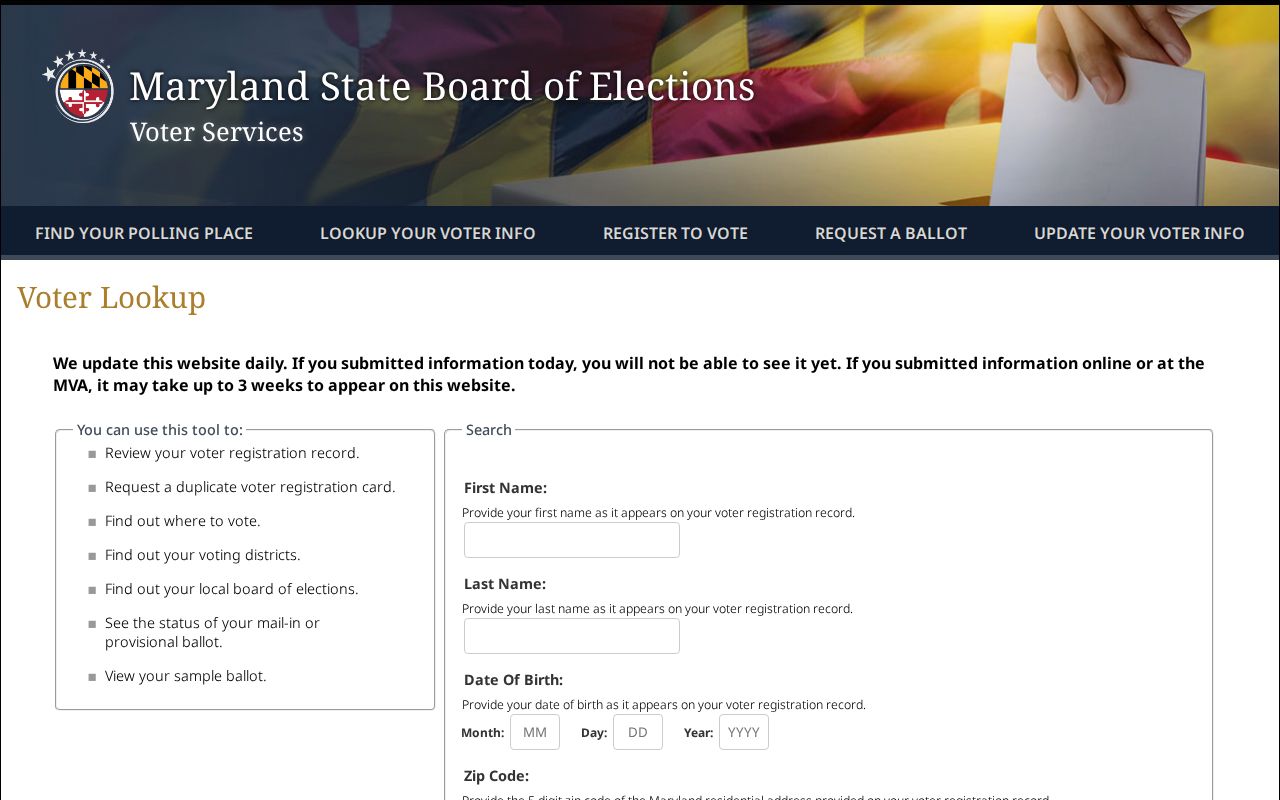
The Prince George's County Board of Elections sits at 1100 Mercantile Lane, Suite 115A, Largo, MD 20774 and lists 301-341-7300. Product requests can take up to 10 business days. A non-match does not prove someone never registered. Daily updates, recent changes, inactive status, and confidential-voter protections all shape what appears.
College Park Vital Record Routes
Vital records confirm events, not a current address. Recent Maryland certificates stay with the Division of Vital Records. Older, unrestricted material moves to the Maryland State Archives. Under State Government §9-1015, births fewer than 100 years old count as restricted. Deaths fewer than 10 years old are restricted too. The Archives route opens older births. It also opens deaths beyond 10 years, marriage licenses, and absolute-divorce or annulment reports. An index lead alone does not create a right to a certified copy.
Who may request a certificate depends on the event. The Maryland birth-record page spells out eligibility and application channels. A person named on the record may qualify. So may a parent. A court-appointed guardian, an authorized representative, or a holder of a court order may also qualify. DVR serves marriage certificates for events from January 1, 2007. Death certificates follow for 2012 and later. Older marriage material goes through the Circuit Court or the Archives. Death-index research can begin there.
The image follows the official eligibility and request information.
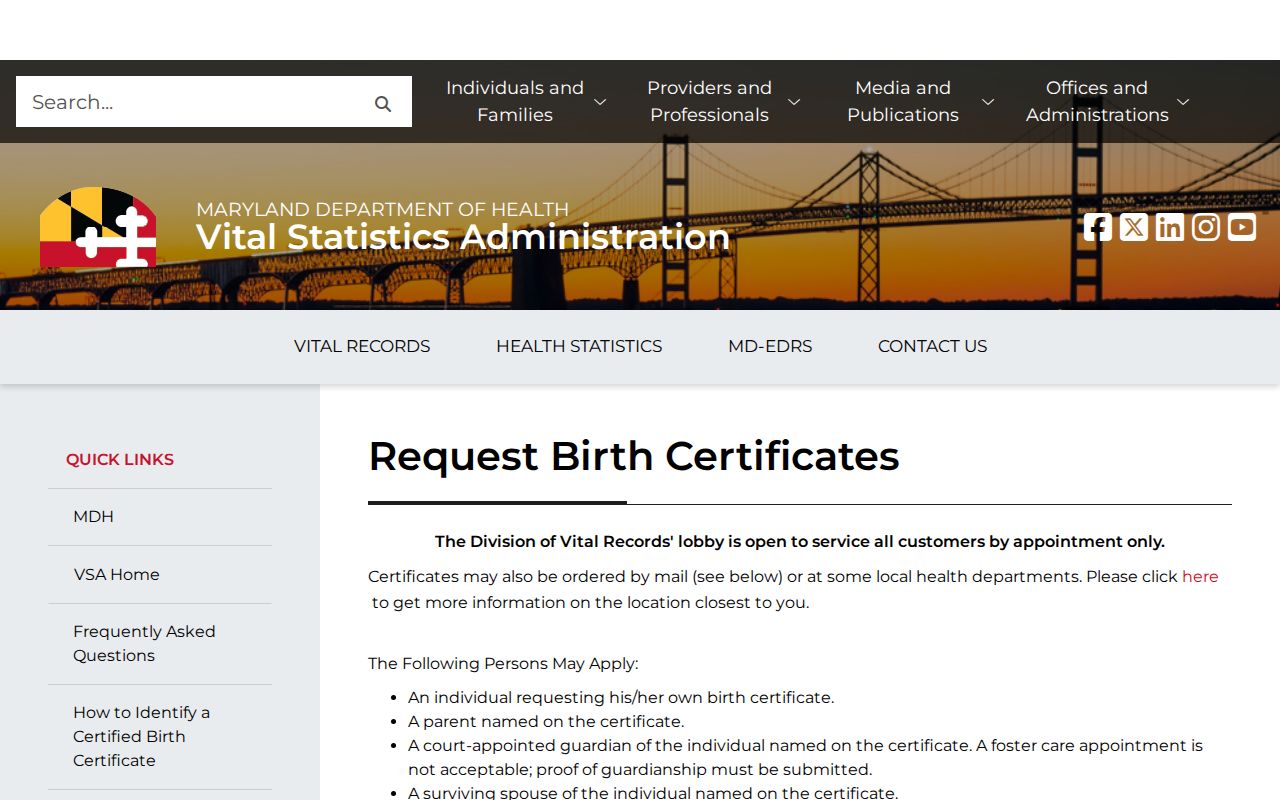
For College Park events, the Prince George's local health service is another documented channel for recent birth and death certificates by appointment at 3003 Hospital Drive, Room 0025, Cheverly. Its listed phone is 301-324-2940; its posted fee and hours differ from the state route, so confirm them before making a request.
Note: The Division of Vital Records warns that it will not ask for a Social Security number or card PIN by phone.
College Park Court Result Fields
Save a CaseSearch result as a narrow note. Do not turn it into a story about a person. The Judiciary's event-history example shows the kinds of fields an indexed detail view can contain. Codes and screen labels vary by court. The public entry may not include the underlying filing. Compare the court, case number, party name, and event date before deciding the result belongs to the College Park resident you are trying to verify.
| Result item | What it can show |
|---|---|
| Case context | Party name, court, case number, and case type surrounding the result. |
| Event code | A short court code, such as a document issued, initial appearance, commitment, release, or bond event. |
| Event date | The date of that indexed event, which can distinguish the timeline from another same-name party. |
| Comment or detail | Limited event information, such as hearing, bail, bond, or status detail where the record exposes it. |
| Availability message | A notice that no electronic record exists or that the case is not subject to electronic inspection. |
Files unavailable online still exist. Ask in person or in writing. The Prince George's Circuit Court sits at 14735 Main Street in Upper Marlboro, with general phone 301-952-3318. Maryland Judiciary courthouse terminals and MDEC access can show more than the public summary, subject to the court's access rules.
When College Park Records Do Not Match
When a College Park name search fails, the cause is usually local. SDAT offers no owner-name search. Town, neighborhood, and ZIP modes are missing too. The database prefers other starting points, and an address, an account identifier, a map reference, or sales criteria works best. The map and parcel tools in PGAtlas can place an address in the city, the county, or a ZIP before an SDAT query. Older entries often carry labels like Old Town, Lakeland, Berwyn, and Branchville, so not every record uses the current College Park name.
Online gaps have formal answers. MDLandRec's current index leads to retired and additional historical indexes. A public Maryland Circuit Court or State Archives workstation needs no remote account sign-in. The Prince George's Room, the County Historical Society, the University of Maryland Archives, and the Maryland State Archives hold directions no current portal reproduces. For a defined government record with no online copy, Maryland's Public Information Act lets a resident ask the custodian directly. Request inspection first. Name the address, the dates, and the record series, and ask for a fee estimate.
General Provisions §4-203 sets the clock. A custodian must give immediate access when practicable. Otherwise the office may take reasonable extra time up to 30 days, with written notice due within 10 working days whenever more than 10 working days are needed. Section 4-206 generally makes the first two hours free. Search and preparation count toward that free allowance. Later costs stay reasonable, and waiver routes exist. The custodian must produce an existing disclosable record rather than build a new list or answer a broad question.
College Park Lookup Coverage Numbers
Coverage dates make useful guardrails. Prince George's Circuit CaseSearch reaches back to 1982 for criminal cases. Civil coverage starts on July 1, 1986. Estate Search covers every Maryland jurisdiction from 1998 forward, with some older Prince George's entries included. FamilySearch probate material bridges 1796 through 1940 for the county. These are collection boundaries only, not a promise that every person, file, or document appears online.
Many records sit outside a general name index. The official MDLandRec guide gives no fixed modern starting year for Prince George's land records, and its 2025 migration added a new account and two-factor process. Older land records survive in other series. State Archives series C1237 covers 1696 through 1851. CE21 indexes 1696 through 1840. A precise book, page, legal description, and party role beats a name alone when asking the archive or courthouse.
College Park Resident Lookup Limits
Public access to Maryland records stops at real boundaries. Safe at Home gives qualifying residents a substitute address plus mail forwarding. Advance notice can shield certain real-property instruments. A protected-voter request can also keep a residential address, email, phone, online confirmation, or mailings out of public view. Courts hold their own power to shield, seal, or expunge records. Adoption matters run through a confidential process. Federal and Maryland privacy rules guard MVA records. Keep that in mind during any College Park resident lookup. A public parcel or deed never names every person tied to it.
Lawful use. Use College Park resident records for personal, lawful research and official verification. Do not use a name, address, or map result to stalk, harass, intimidate, or expose a protected person.
Adoption is different. Maryland's Adoption Search, Contact and Reunion Services is the official path for adult adoptees, birth parents, and birth siblings who want contact through mutual consent and a Confidential Intermediary. That route is far safer than piecing together a private family history from scattered public records in a College Park residents directory or street directory. Errors happen too. When an official record is wrong, ask its custodian about the correction process. For CaseSearch data, go to the court where the case was filed. For assessment data, contact SDAT. Voter records belong to the election office, and vital-record amendments go through MDH procedures.