
Finding College Park Residents From Records
Begin with a fact that is already solid. That may be a full name, a street address, a parcel account, or the year a family lived in College Park. The Maryland assessment record works best when the address is known. It identifies a recorded owner, the premises, a tax mailing address, parcel keys, and a deed reference. A deed, court index, directory issue, or probate file can then test whether the same name belongs to the same person.
Each source answers a different question. The property roll is not a household list. The voter self-lookup serves the voter, not the public. Printed directories preserve a name, telephone, or address for one issue. They can still omit people. Keep the date and source with every finding. That habit makes a College Park residents directory search useful for family history, reconnecting, estate work, and checking an official record trail. Just do not overstate what any single record proves.
- Match the address to the State assessment card and record its premises address, mailing address, parcel fields, and deed reference.
- Use the parcel in PGAtlas to check the College Park boundary, neighborhood context, and nearby geography.
- Follow the recorded deed reference in MDLandRec, then compare a name against a second independent record such as a court index or historical directory.
- For a historic household, ask the Prince George's Room or the County Historical Society for the relevant printed run, microfilm, obituary, or property file.
- When the record is not online, make a focused Maryland Public Information Act request to the custodian that holds the defined record series.
Note: A no-result reflects coverage, not College Park absence.
College Park Resident Records Offices
College Park sits inside Prince George's County. Its resident records sit at city, county, and state levels. City Hall keeps municipal minutes, permits, and city records requests. The county Circuit Court keeps recorded land instruments. SDAT runs the public assessment search, while elections and courts maintain their own restricted paths. Treat the offices below as starting points rather than interchangeable databases. The city clerk route matters for agendas, written requests, parking records, and permit context. County land and court indexes lead to recorded cases. State systems handle assessment, voter, and vital-record access. Once the street and parcel are confirmed, the College Park street directory helps. It gives the full address-by-address sequence.
Land Records Division
Judicial Administrative Services
14701 Gov. Oden Bowie Drive, Upper Marlboro, MD 20772
301-780-2253
Maryland SDAT
State real-property assessment portal
Choose Prince George's County before searching
Public online search
County Board of Elections
1100 Mercantile Lane, Suite 115A
Largo, MD 20774
301-341-7300
College Park Property Record Keys
SDAT is the main College Park address entry point. Its primary form asks for a county and a search method. Address or Street suits a known location. Account Identifier and Map Reference work when an earlier record supplies those keys. Sales is a separate mode. It covers transfer and assessment criteria. The form offers no owner-name, town, neighborhood, or ZIP search, so a name-only hunt needs another lead.
Read the two address fields separately. The premises address is the physical place local government assigns. The mailing address is where tax notices go, and it can belong to an organization or representative. A principal-residence flag is owner tax information, not a roll of everyone at the property, so pair the assessor's record with a dated deed, directory, or other independent source.
| SDAT field | Input | College Park use |
|---|---|---|
| County | Required dropdown | Select Prince George's County. |
| Search Method | Required dropdown | Address/Street, Account Identifier, Map Reference, or Sales. |
| Street Address | Number and street text | Try the full name without a direction, suffix, or punctuation when needed. |
| Account or map fields | Segmented text | Use a known assessment or parcel lead, not a guessed household name. |
A Prince George's tax-sale listing shows why context matters. It can expose an account and address in a dated tax-sale setting. It proves nothing about current owners or occupants.
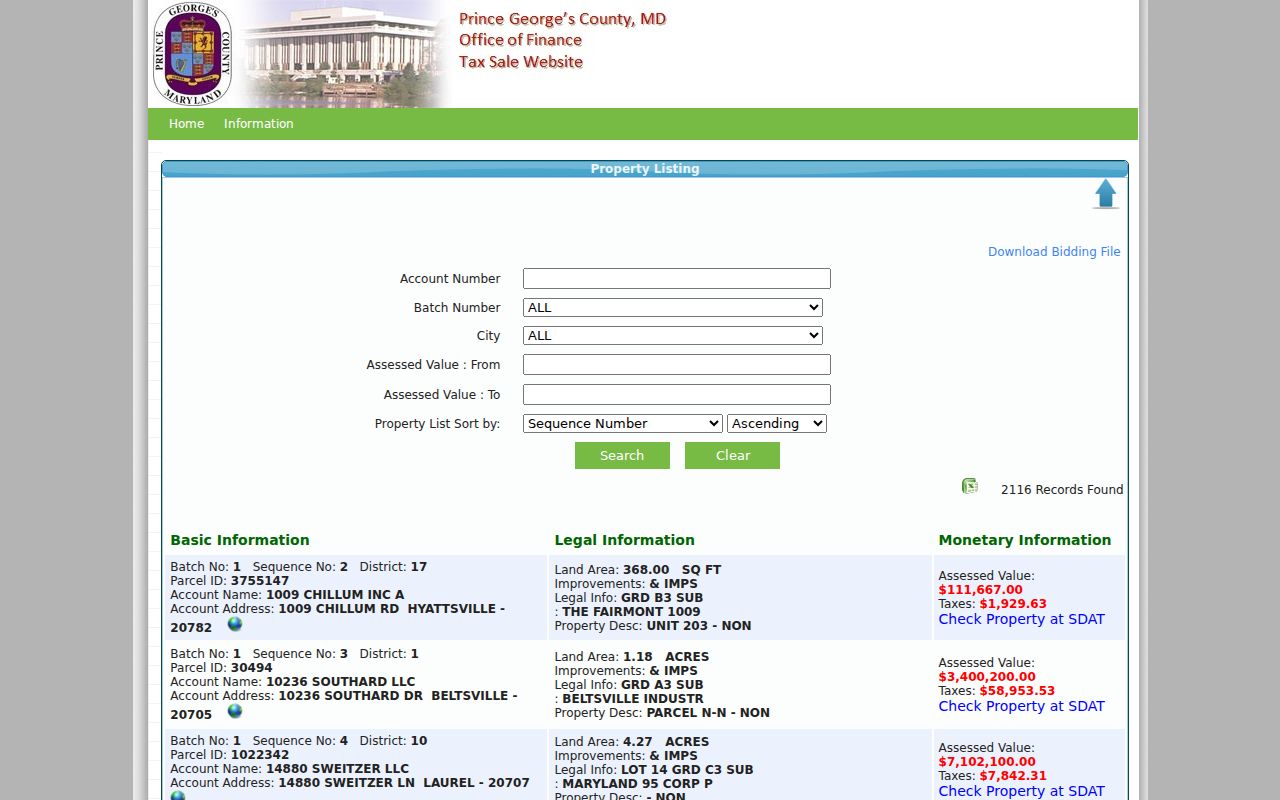
The result layout moves an account or address to the official assessment card. Deed and parcel details supply the firmer next step.
College Park Parcels on PGAtlas
PGAtlas adds the map layer the assessment card lacks. Its text search finds an address, parcel, name, or landmark once autocomplete starts. Criteria tools filter property and development information. Map tools can identify a feature, select a polygon, or inspect a small proximity area. Parcel, municipal, ZIP, zoning, imagery, district, and development layers help separate a College Park premises from its postal or neighborhood label. Geometry is not ownership proof. PGAtlas states its parcel geometry comes from deeds, plats, tax maps, and related mapping material. It is not a survey or legal description. Capture the parcel context there. Then open the assessment card and the recorded instrument. This works well when a College Park street crosses an older community label or municipal boundary.
- Parcel
- A mapped unit of land tied to assessment and plat identifiers.
- Premises address
- The physical address used by local-government address systems.
- Index
- A searchable pointer to a record, not necessarily the record image or a certified copy.
- Criss-cross directory
- A historical directory arranged by street address rather than by surname.
College Park Voter And Court Limits
Maryland's voter search is built as a self-lookup. It requires a first and last name, a date of birth, and a Maryland residential ZIP. Street number and middle initial are optional refinements. A successful match can return voter details, districts, and a polling place. It can also return the local board and sample-ballot material. What it will not do is list every voter on a College Park street. Broader county and statewide voter products run through a request process with an oath and fees. Limits there are set by Election Law and COMAR rules.
Maryland CaseSearch is a different animal: a party-name index. It allows searches by name, case number, court, and case type. The system is protected by a CAPTCHA and capped at 500 results. Protected case classes are excluded. Prince George's Circuit Court coverage starts in 1982 for criminal matters. Civil coverage begins July 1, 1986. Treat any match as a docket lead only. A same-named party is not automatically the person you mean.
The Maryland sex-offender registry serves a public-safety purpose. It carries its own legal-use notice. It is not a College Park household directory.
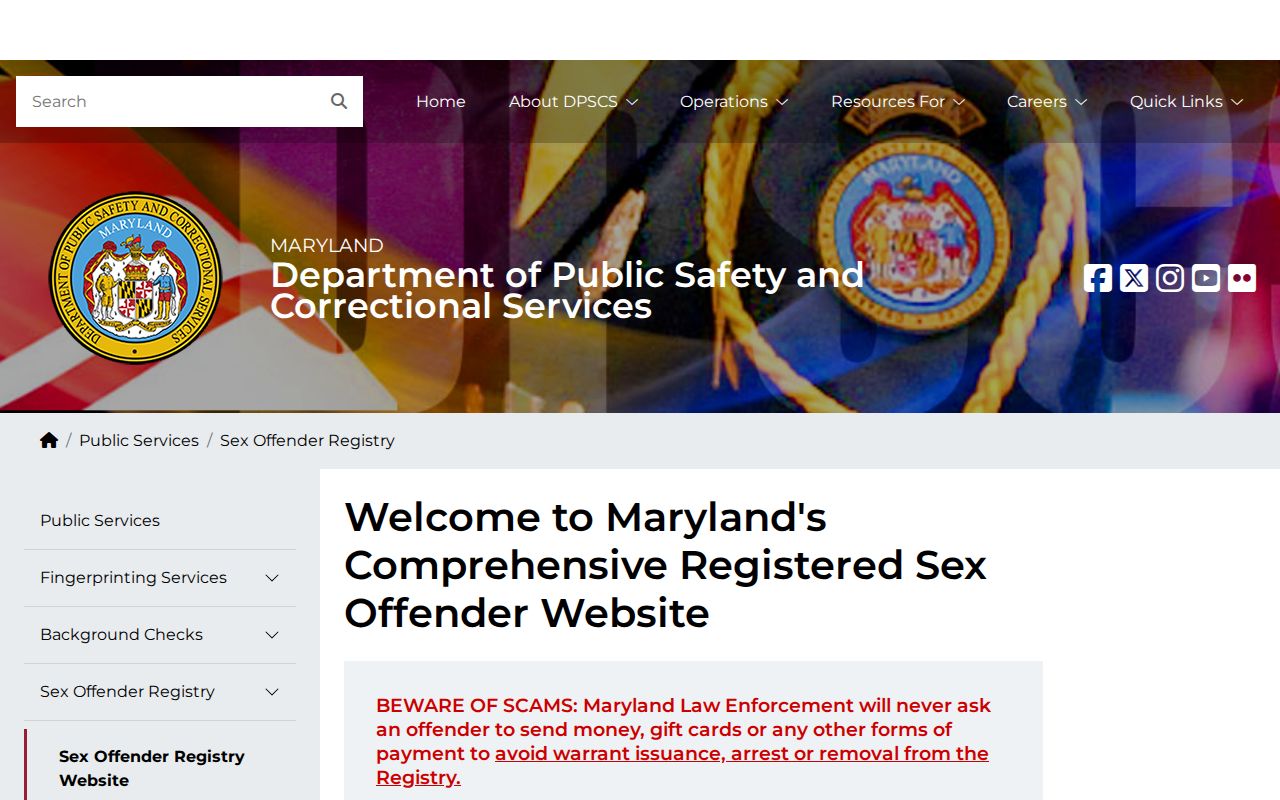
Follow the registry's stated purpose and date limits exactly. No registry can prove that everyone tied to an address still lives there now.
Note: Court, voter, and public-safety results should be checked against their date and custodian before anyone relies on them.
Current College Park Resident Listings
No city-operated roll lists every College Park resident. What official current sources offer instead is a record relationship: property ownership, a party named in a recorded instrument, a voter self-match, a public filing, or a city role. The table lays out that practical distinction. It keeps a property, voter, or court result from being read as more complete than it truly is.
| Source | What it may confirm | Custodian | Access |
|---|---|---|---|
| SDAT parcel card | Recorded owner, tax mailing and premises addresses, transfer reference | Maryland SDAT | Public informational search |
| MDLandRec | Grantor, grantee, instrument, book, page, and recorded image | Land Records / Circuit Court | Self-research; image account access |
| Voter self-lookup | The requesting voter's own registration information | Maryland State Board of Elections | Identity-gated self-service |
| CaseSearch | Indexed court-party and docket details | Maryland Judiciary | Public summary with exclusions |
| City Clerk archives | Meeting, board, notice, and city-created material | College Park City Clerk | Online archive or written request |
For one person with a known name and date, compare two independent entries. Address work should start with the parcel and the deed. Older printed leads belong on the city directory shelf, not in a current-record query.
College Park Requests Beyond Portals
The Maryland Public Information Act opens a path to existing disclosable records. It does not force an office to build a new resident list. It does not force an office to answer a vague question. Give the right custodian a defined record type, an address or subject, and a date range. College Park city-created material goes to the City Clerk. County permit material belongs to DPIE. Court and probate files stay with their clerks. Voter products follow the election request process.
Under the MPIA, access is immediate whenever practicable. When more than ten working days are needed, the custodian must send written notice explaining why. The notice includes an estimate and any possible fee. The first two hours of search and preparation are free under the fee rule. Reasonable actual costs may follow. Ask to inspect before ordering copies. Request a fee estimate whenever the scope runs broad.
College Park Court And Custody Sources
A name can surface in a court, probate, custody, or registry system. It may not reveal where that person lives. CaseSearch constrains results by jurisdiction and historical coverage. The courthouse may hold more accessible file material. The Clerk cannot run a title or identity search over the phone. Request a specific case file in person or in writing. Include the case number, party name, filing date, and division.
The state inmate locator carries its own custody-system and date limits. It covers the state facilities described by DPSCS. It is not a universal county roster, and it cannot establish present residence. For Prince George's County custody questions, the county locator page offers phone contacts but no working public web search. Verify custody details directly with the holding agency or court.
The Maryland DPSCS inmate locator shows the state search route along with its coverage warning.
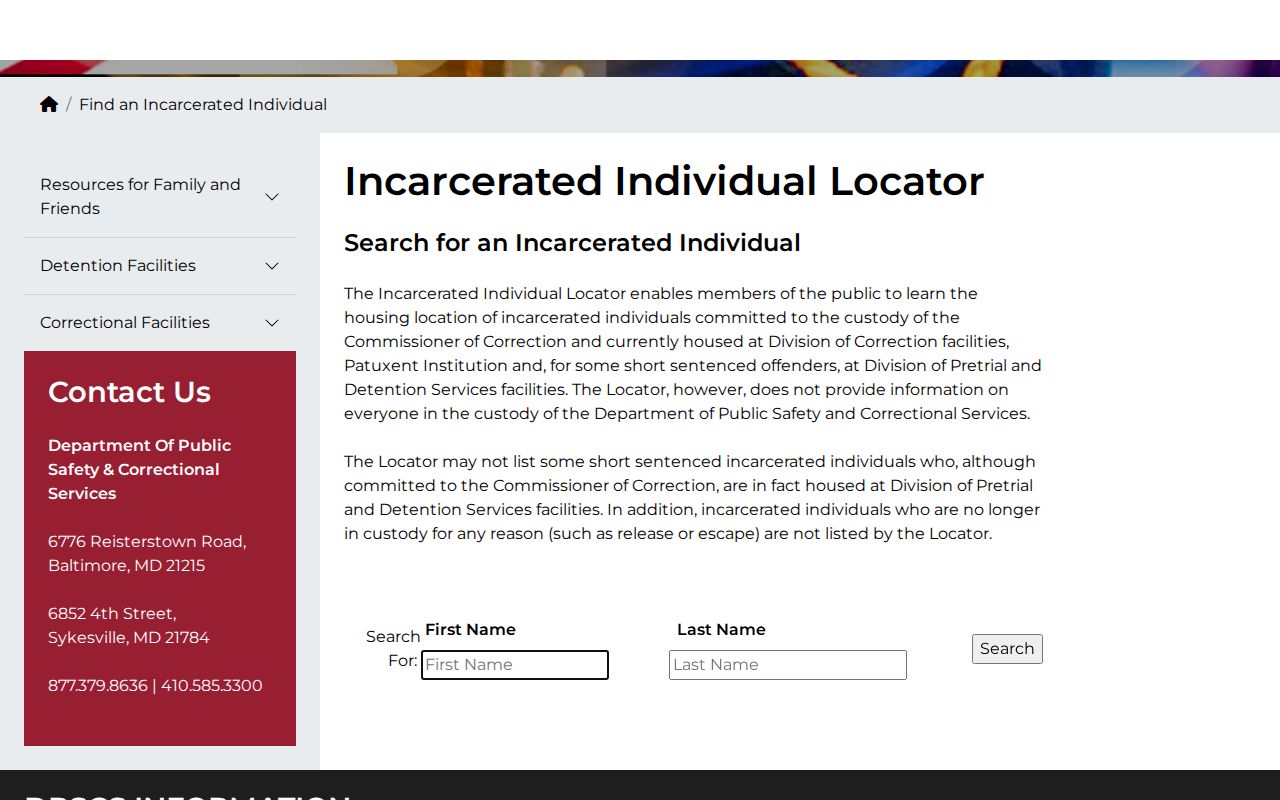
Treat a custody result as a time-stamped official record and nothing more. Confirm court details with the agency or court that created them.
College Park ZIP Record Geography
College Park spans ZIPs 20740, 20741, and 20742, but those codes track postal delivery, not city boundaries. 20740 serves as the primary street-address code. 20741 is PO Box-oriented. 20742 is the University of Maryland's unique-institution code. A postal city printed in a record may therefore differ from the incorporated boundary or an older neighborhood name.
Confirm the address with USPS first, then use PGAtlas or the Maryland boundary layers for city, county, and parcel context. SDAT offers no ZIP-based search. A ZIP works to confirm a postal address or refine an identity-gated voter self-search, never to generate a complete College Park residents directory. The ZIP code directory explains the boundary difference further.
Historical College Park Resident Directories
College Park's directory history is suburban rather than municipal. The published record here runs through regional series that covered several towns at once. Nelson's Washington Suburban Directory survives for 1918 and 1923. Polk issued suburban volumes for 1927-28, 1930-31, and 1954-55, and later printed combined College Park, Hyattsville, Mount Rainier, and Riverdale issues in selected years from 1963 through 1971. Missing years between these runs are normal for suburban publishing. A gap means you should scan neighboring issues and library holding catalogs, not assume a household vanished from the records.
Telephone directories add another layer. The Library of Congress has digitized its 1963/64 and 1966/67 telephone books for the area, and each scan can reveal a subscriber's name, a compressed street and locality, and the number listed for that printed issue. Expect limits, though. A phone listing says nothing about a spouse, an occupation, other household members, or where anyone lives today. For the complete local trail of these volumes, see the College Park city directory collections.
College Park Library History Desk
When a modern portal dead-ends, the Prince George's Room at the Hyattsville Branch steps in. Its noncirculating shelves hold historic newspapers on microfilm. They also hold local genealogical journals and a reader for film and fiche. Digitized historic photographs arrive through Digital Maryland. Staff respond best to a specific publication title, year, and the old locality name. They respond less well to a vague request for a College Park listing.
The County Historical Society's Frederick DeMarr Library deepens the trail with house-history and genealogy material. Its holdings include maps and obituary files. It also offers church and cemetery leads, published genealogies, newspaper runs, subdivision plats, the 1940 Franklin Atlas, and property files. Turn to it once a directory, deed, or census finding needs local context. Confirm hours before visiting.
Note: Library and archive material can document a dated historical association. It cannot document a current resident roster.
College Park's 1912 Records Gap
The same ground carried older names. Records may say Branchville, Berwyn, Lakeland, or Old Town instead of College Park. Growth tracked the rail, streetcar, Route 1, and subdivision eras. Old Town plats date to 1889. Calvert Hills and later neighborhoods carry their own timelines. Treat each name as a search term, not a decorative label.
Pair the historic locality with the address, directory year, plat, or census enumeration district. The University of Maryland Archives documents one crucial gap. A 1912 fire destroyed many campus documents. Later student newspapers, oral histories, maps, and archives supply context. An early campus-adjacent record did not survive. A missing entry reflects that loss. It does not mean the person was never there.
College Park Protected Address Rules
Maryland draws firm lines around public-record access. The Safe at Home program gives eligible residents a substitute address. It can shield qualifying property instruments when notice precedes recording. Voter confidentiality protects a residential address, email, and phone. Sealing, shielding, expungement, adoption confidentiality, vital-record eligibility, and motor-vehicle privacy guard still more.
Compiled commercial profiles deserve skepticism. Data can be stale. It can merge strangers who share a name, or cling to an old address. No such profile replaces the custodian's record or overrides a protection program. Check official dates and fields. Request corrections from the office when an official index errs. Never rebuild a protected address from parcel, postal, or neighboring-record clues.
College Park Official Scam Checks
Records research sometimes demands fees or identity documents. Maryland's vital-records office warns it never asks for a Social Security number in an unsolicited call. It also never asks for a card PIN. Court and police scam notices agree: a caller's payment link or callback number proves nothing. Type the official domain yourself. Cross-check contact details on official pages. Ask for the record type, case number, or published fee.
Save the email, envelope, text, or payment evidence when a request smells wrong. A genuine custodian will explain the record route and its access limits. No legitimate office demands gift cards, wires, a PIN, or bank logins on the spot. County and state agencies can then steer a report to consumer protection or law enforcement.